For years, AI website builders were dismissed as tools for simple landing pages—"toys" that generated spaghetti code you couldn't actually scale. But as we move through 2026, the narrative has shifted.
Major tech analysts like Unite.AI and infrastructure leaders like Superblocks are now flagging Lovable.dev as a legitimate primary solution for startups. Here is how Lovable solved the "hard logic" problem and why it’s winning the speed-to-market race.
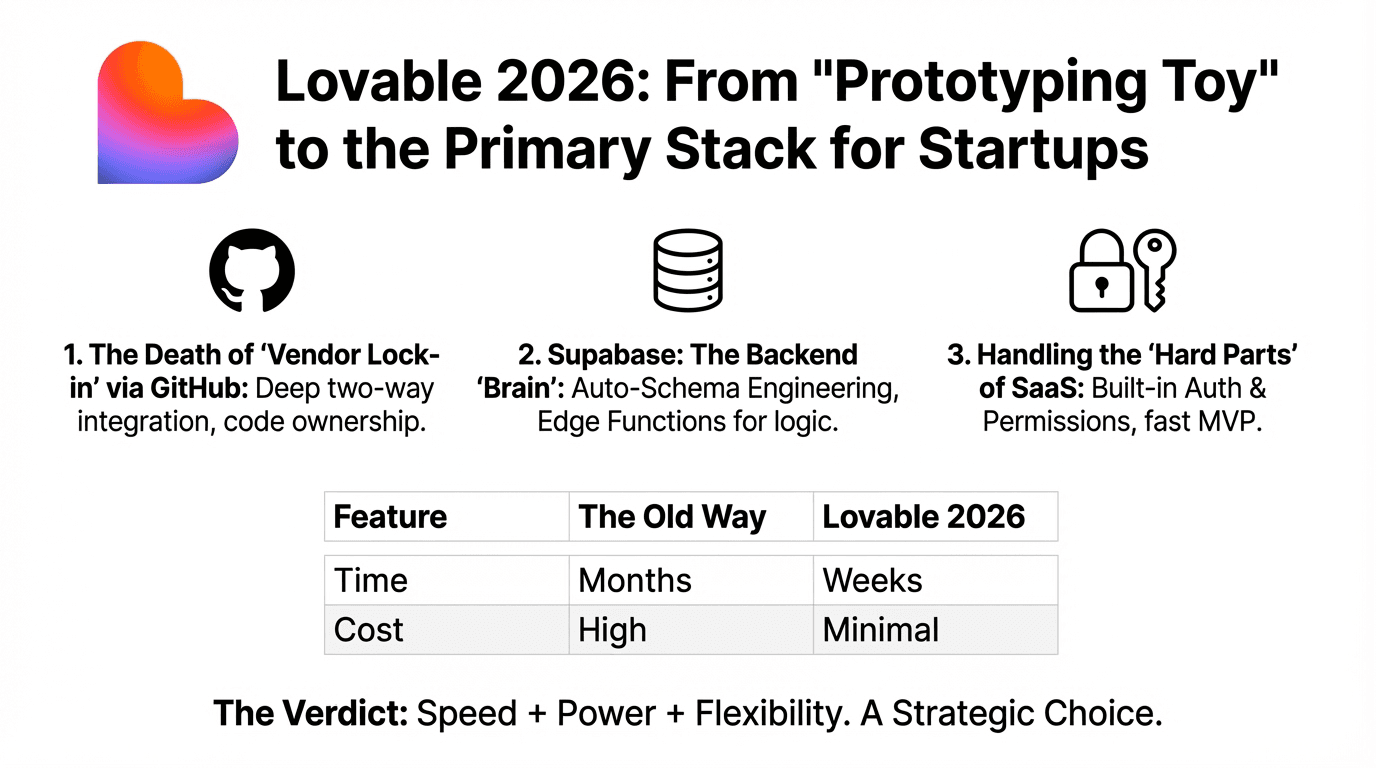
1. The Death of "Vendor Lock-in" via GitHub
The biggest fear for any founder is building on a platform they don't own. Lovable solved this with Deep GitHub Integration.
The Shift: Lovable doesn't just host your site; it manages your repository. It supports two-way synchronization: AI edits on Lovable reflect in your repo, and manual code changes by your developers reflect back in Lovable.
Why it matters: Your code is no longer trapped. If you outgrow the platform, you have a professional-grade codebase ready for manual scaling.
2. Supabase: The Backend "Brain"
Hard logic requires a hard database. Lovable’s native integration with Supabase has turned it into a full-stack powerhouse.
Auto-Schema Engineering: Instead of just creating UI fields, Lovable now designs complex relational database schemas. It automatically handles foreign keys, indexes, and Row Level Security (RLS).
Logic at the Edge: Lovable 2026 can now generate Supabase Edge Functions (TypeScript). This allows the AI to handle server-side logic like Stripe payments, automated emails, and heavy data processing without slowing down the frontend.
3. Handling the "Hard Parts" of SaaS
Building a login system and data permissions used to take weeks. Now, it's a prompt away.
Auth & Permissions: Lovable leverages Supabase Auth to build multi-tenant SaaS platforms where data privacy is baked in, not tacked on.
The "Primary Solution" Status: For startups, this means shipping an MVP in days that is built on the same architecture (React, Vite, Tailwind, Supabase) as a billion-dollar company.
Comparison: Why Startups are Pivoting
Feature | The Old Way (Outsourcing) | The Lovable 2026 Stack |
Development Time | 3 - 6 Months | 1 - 2 Weeks |
Initial Cost | $15k - $50k | Subscription-based / Minimal |
Ownership | High risk of technical debt | Clean GitHub-managed code |
Scalability | Manual & Expensive | AI-assisted with manual fallback |
The Verdict: In 2026, choosing Lovable isn't just a "fast" choice—it's a strategic one. It provides the speed of No-Code with the power and flexibility of a custom-coded stack.