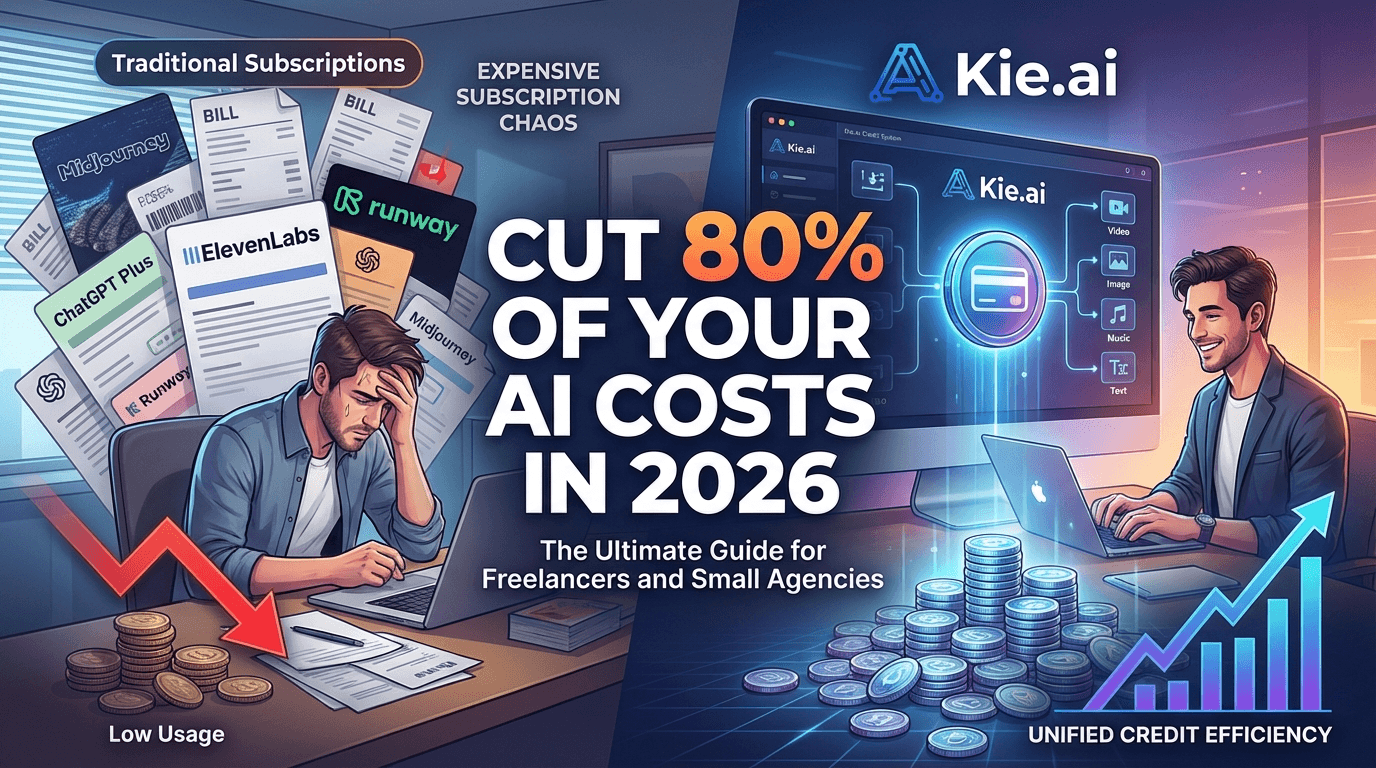
If you're a freelancer or running a small agency in 2026, you've probably noticed something painful: your AI tool subscriptions are quietly eating into your profits. Every month, you're paying for Midjourney, Runway, ElevenLabs, and half a dozen other platforms—whether you use them fully or not. Sound familiar?
Here's the uncomfortable truth: most creatives are losing 30-50% of their subscription value to unused capacity. You're essentially paying for a gym membership you only use twice a week, except instead of abs, you're not getting the AI content you need.
But there's a smarter way forward. Let me show you how the shift from rigid subscriptions to flexible credit systems can save you thousands of dollars annually while actually improving your creative workflow.
The Real Problem: Death by a Thousand Subscriptions
Let's paint a picture of the typical 2026 freelancer or small agency setup:
The Traditional Monthly Bill:
Midjourney Pro: $60/month for image generation
Runway Pro: $35/month for video creation
ElevenLabs Creator: $22/month for voice synthesis
ChatGPT Plus: $20/month for text generation
Canva Pro: $15/month for design work
Total: $152/month or $1,824/year
Now here's the kicker—according to industry data, most freelancers only use about 40-60% of their allocated capacity across these tools. You're paying for 15 Fast GPU hours on Runway but only using 8. You have 100,000 ElevenLabs credits that reset before you touch half of them. Your Midjourney subscription sits idle for weeks between projects.
This isn't just inefficient—it's financially unsustainable, especially when client budgets tighten and competition increases.
The Hidden Costs You're Not Tracking
Beyond the obvious monthly charges, there are invisible costs eroding your bottom line:
Cognitive overhead: Managing 5-10 different billing cycles, each with its own renewal date
Forgotten subscriptions: That $30/month tool you meant to cancel three months ago
Forced upgrades: Hitting limits on one platform while others sit unused
Cash flow strain: Fixed costs whether you have projects or not
Feature redundancy: Paying for overlapping capabilities across platforms
For a freelancer earning $60,000/year, spending nearly $2,000 on underutilized subscriptions represents 3% of gross income—money that could fund marketing, equipment upgrades, or simply improve your quality of life.
Enter the Credit-Based Revolution: The Kie.ai Solution
Here's where the landscape shifts dramatically. Platforms like Kie.ai are fundamentally changing how creators access AI tools by replacing the "subscription straitjacket" with a flexible credit system.
What makes this different?
Instead of paying for 5-10 separate subscriptions, you purchase a pool of credits that works across multiple AI models—video generation, image creation, music synthesis, and more. You only spend credits when you actually generate content.
How Kie.ai's Unified Credit System Works
Kie.ai operates as a unified API platform that provides access to premium AI models through a single account:
Available Models:
Video Generation: Veo 3, Veo 3 Fast, Runway Gen-3 Alpha, Runway Aleph
Image Generation: Midjourney v7, OpenAI 4o Image, Flux.1, Nano Banana
Music Creation: Suno V3.5 through V4.5 Plus
Text/Chat: Multiple language models for content creation
The Credit Economics:
The platform uses a straightforward pricing model: $0.005 per credit (or $5 per 1,000 credits). Different operations consume different amounts of credits based on computational requirements.
Here's what that looks like in practice:
Task | Credit Cost | Dollar Cost | Traditional Platform Cost |
Veo 3 Fast Video (8s) | 60 credits | $0.30 | $6.00 (Replicate/Fal.ai) |
Veo 3 Quality Video (8s) | 250 credits | $1.25 | $6.00 (Replicate/Fal.ai) |
Midjourney Image (Fast) | 8-12 credits | $0.04-$0.06 | Part of $60/month |
OpenAI 4o Image | 6 credits | $0.03 | Complex token pricing |
Notice the dramatic difference? For the same Veo 3 video generation, you're paying $0.30-$1.25 through Kie.ai versus $6.00 on traditional platforms. That's 75-95% savings on video generation alone.
The Real-World Cost Comparison: Monthly Scenarios
Let's run the numbers for three common freelancer/agency scenarios to see the actual savings.
Scenario 1: The Social Media Content Creator
Monthly Output:
20 short-form videos (8-10 seconds each)
50 images for posts and thumbnails
10 voiceovers for reels
Traditional Subscription Approach:
Runway Standard: $15/month (625 credits = ~125s of Gen-3 Alpha Turbo)
Midjourney Standard: $30/month
ElevenLabs Starter: $5/month
Total: $50/month
Kie.ai Credit Approach:
20 videos (Veo 3 Fast @ 60 credits each): 1,200 credits = $6.00
50 images (Midjourney Fast @ 10 credits each): 500 credits = $2.50
10 voiceovers (assuming Suno API for music beds @ ~20 credits each): 200 credits = $1.00
Total: $9.50/month
Monthly Savings: $40.50 (81% reduction) Annual Savings: $486
Scenario 2: The Marketing Agency (5-10 Clients)
Monthly Output:
50 marketing videos
200 social media images
30 product visualization renders
20 custom music tracks
Traditional Subscription Approach:
Runway Pro: $35/month
Midjourney Pro: $60/month
ElevenLabs Creator: $22/month
Suno subscription or alternative: ~$25/month
Total: $142/month
Kie.ai Credit Approach:
50 videos (mix of Veo 3 Fast @ 60 credits): 3,000 credits = $15.00
200 images (Midjourney @ 10 credits average): 2,000 credits = $10.00
30 high-quality renders (4o Image @ 6 credits): 180 credits = $0.90
20 music tracks (Suno V4 @ estimated 40 credits/track): 800 credits = $4.00
Total: $29.90/month
Monthly Savings: $112.10 (79% reduction) Annual Savings: $1,345
Scenario 3: The Video Production Freelancer
Monthly Output:
10 client videos with AI assistance (concept, B-roll, effects)
40 preview thumbnails
15 voiceover narrations
Traditional Subscription Approach:
Runway Pro: $35/month
Midjourney Standard: $30/month
ElevenLabs Creator: $22/month
Total: $87/month
Kie.ai Credit Approach:
10 longer-form video generations (Runway Gen-3 or Veo 3 Quality): 2,500 credits = $12.50
40 thumbnails: 400 credits = $2.00
15 voiceovers (via integrated audio APIs): 300 credits = $1.50
Total: $16.00/month
Monthly Savings: $71 (82% reduction) Annual Savings: $852
Beyond Cost Savings: The Strategic Advantages
While the cost reduction is impressive, the benefits of a unified credit system extend far beyond your monthly bank statement.
1. Improved Cash Flow Management
With traditional subscriptions, you pay upfront for capacity you might use. With credits:
Pay only when you generate: Slow month? Your costs drop proportionally
No wasted capacity: Every dollar spent produces actual output
Predictable scaling: Busy season? Buy more credits as needed without upgrading entire tiers
This is particularly valuable for freelancers with variable workloads. Instead of maintaining expensive subscriptions "just in case," you match spending to actual project revenue.
2. Eliminated Subscription Fatigue
How many times have you:
Forgotten to cancel a trial that auto-renewed?
Paid for a platform you didn't touch for months?
Lost track of which card is attached to which service?
A single credit pool means:
One billing relationship to manage
One renewal date to track
One invoice to reconcile
One customer service contact if issues arise
The cognitive load reduction alone is worth considering—time spent managing subscriptions is time not spent creating or finding clients.
3. Technology Flexibility
Here's a subtle but powerful advantage: you're not locked into specific models.
With separate subscriptions, switching from Runway to Veo 3 means canceling one service and starting another—a friction point that keeps you using suboptimal tools.
With Kie.ai's unified platform:
Test different models without commitment
Choose the best tool for each specific project
Adapt as new, better models are released
Compare outputs side-by-side before committing credits
This flexibility means you're always using the most effective tool for the job, not just the one you're paying for anyway.
4. Transparent Usage Analytics
Subscription platforms rarely show you what you're actually using versus what you're paying for. Credit-based systems provide clear visibility:
Which models consume the most credits
Which projects are most/least cost-effective
Where you can optimize workflows
Historical usage patterns for budgeting
This data-driven approach helps you make smarter creative and business decisions.
Making the Transition: Practical Implementation
If you're convinced but wondering how to actually make this shift, here's a step-by-step approach that minimizes disruption:
Phase 1: Audit Your Current Spend (Week 1)
List all AI subscriptions with monthly costs
Track actual usage for one typical month
How many images did you generate?
How much video?
Which tools did you barely touch?
Calculate utilization rate: Actual use / Maximum capacity
Identify overlap: Tools with redundant features
Phase 2: Pilot with Kie.ai (Week 2-4)
Start small: Purchase $25-50 in credits (5,000-10,000 credits)
Run parallel: Keep current subscriptions while testing
Compare outputs: Quality, speed, ease of use
Track costs: Monitor credit consumption versus subscription costs
Document workflow: Note any adjustments needed
Phase 3: Optimize and Scale (Month 2)
Cancel redundant subscriptions (but keep one month overlap for safety)
Establish credit budget based on pilot data
Set up monitoring: Track monthly credit burn rate
Create templates: Standardize prompts for efficiency
Educate team: If applicable, train collaborators on the new system
Phase 4: Maintain and Refine (Ongoing)
Review quarterly: Adjust credit purchasing based on workload trends
Stay current: Test new models as they're added to Kie.ai
Optimize prompts: Better prompts = fewer regenerations = lower costs
Plan for peaks: Buy credit packs before busy seasons
Potential Concerns and Honest Answers
Let's address the legitimate hesitations you might have:
"What if I run out of credits mid-project?"
Fair concern. Solutions:
Buffer strategy: Maintain 20-30% more credits than you typically use
Instant top-up: Credits can be purchased immediately when needed
Project planning: Estimate credit needs upfront for client work
With subscriptions, you can also "run out" (hit monthly limits), requiring expensive per-hour top-ups. Credits simply shift when you pay, not whether you can continue working.
"Will this work for my specific niche?"
Kie.ai covers the core AI creation needs:
Video (multiple models including Veo 3 and Runway)
Images (Midjourney, Flux, 4o Image)
Audio (Suno for music)
Text (various language models)
If your work requires highly specialized tools not available, you might keep one niche subscription alongside Kie.ai credits—still a massive reduction from 5-10 subscriptions.
"Is the quality comparable to direct platforms?"
Yes - Kie.ai provides access to the actual models from Midjourney, Runway, Google, etc. You're not getting a "budget version." The outputs are identical because you're accessing the same underlying technology, just through a unified API rather than multiple interfaces.
"What about customer support and reliability?"
According to platform documentation, Kie.ai offers:
99.9% uptime commitment
24/7 monitoring and support
Comprehensive API documentation
Developer playground for testing
As a smaller platform compared to giants like OpenAI, there are trade-offs. But for most freelancers and small agencies, the cost savings and efficiency gains far outweigh the minimal difference in support infrastructure.
The Future of AI Tool Economics
The shift from subscriptions to credit-based models represents a broader trend in software monetization—one that better aligns provider incentives with user needs.
Why this model makes sense for 2026 and beyond:
AI costs are dropping: As computational efficiency improves, per-unit costs decrease—credits let you benefit immediately
Model diversity is increasing: New models launch monthly; credits let you experiment without subscription lock-in
Workflows are multimodal: Modern projects blend video, image, audio, text—unified credits match this reality
Economic uncertainty: Variable costs protect you better during slow periods than fixed subscriptions
Platforms like Kie.ai aren't just cheaper—they're structurally better aligned with how creators actually work in 2026.
Taking Action: Your 30-Day Challenge
Here's my challenge to you: Calculate your actual AI tool ROI over the next 30 days.
Week 1-2: Track every subscription charge and every piece of content you generate
Week 3: Calculate your cost per output (video, image, audio file)
Week 4: Price out the same outputs using Kie.ai's credit system
I'm confident you'll find savings of 60-80% on what you actually use. The question isn't whether you can save money—it's what you'll do with the extra cash flow.
Conclusion: Working Smarter, Not Harder
The subscription model was built for a different era—when software companies needed predictable revenue and users had predictable needs. But AI content creation is anything but predictable. Projects vary wildly in scope, deadlines compress and expand, and the best tools change quarterly.
The credit-based approach through platforms like Kie.ai matches this new reality. You pay for results, not potential. You access the tools you need, when you need them, without the overhead of managing a subscription empire.
For freelancers and small agencies operating on tight margins, this isn't just about saving money—though saving $500-$1,500+ annually certainly helps. It's about building a more sustainable, flexible, and stress-free creative practice.
The tools should serve you, not the other way around. It's time to make that a financial reality.
Ready to see your potential savings? Visit Kie.ai to explore their pricing calculator and free trial credits. Start small, test thoroughly, and make the data-driven decision that's right for your business.
Note: Pricing and features mentioned in this article are based on January 2026 information. Always verify current pricing on official platforms before making financial decisions.